Those who get to know Stichting Theia quickly discover that it is not a fund that operates from a distance. No funding for long-running scientific research or abstract policy documents, but concrete projects that aim to make life a little better for people in the Rijnmond region — preferably starting today.
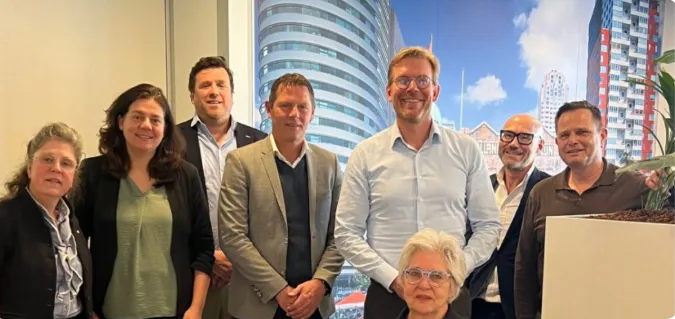
We spoke with Peter van Zuidam, board advisor, and Sabine-Cécile Severein-Borst, secretary of the Theia board, about the origin of the fund, their involvement in the neighbourhoods and the way Stichting Theia focuses on tangible social impact.
A fund with roots in Rijnmond
Stichting Theia was founded in 1984, with a clear regional mission. The fund originated from the assets of the former supplementary insurance of the Rotterdam health insurance fund. When that fund ceased to exist, one thing was essential for the founders: the money had to go back to the region and to the people who had contributed to it.
That choice defines what Stichting Theia stands for to this day. The fund supports projects that have an impact on residents of the Rijnmond region, including Rotterdam, Schiedam, Vlaardingen, Capelle aan den IJssel and surrounding municipalities. Theia is affiliated with health insurer Zilveren Kruis.
“We strongly believe in solutions that are connected to everyday life. In the neighbourhood, in people's daily behaviour.”
Health starts outside healthcare
Stichting Theia's focus is on health and wellbeing, but with a broad perspective. Not just care, but also prevention, participation and activation play a major role. The fund believes in the shift from 'illness and care' to 'health and behaviour'.
Board advisor Peter sees this reflected daily in the applications:
“Healthcare is under enormous pressure. We simply don't have enough people to solve everything within the healthcare system. That's why we strongly believe in solutions that are connected to everyday life. In the neighbourhood, in people's daily behaviour.”
This can be something big, but equally something seemingly small. Think of a neighbourhood initiative where residents learn to cook healthier together, or a local project that helps people get ahead of debt, stress and health problems.
Close to the community
What sets Stichting Theia apart is the way the fund is involved. Not just financially, but also as an engaged partner in dialogue. The board and office deliberately maintain short lines of communication with applicants.
Sabine: “In recent years, we have moved ever closer to the Rijnmond community. Less distance, more contact. We see that neighbourhood initiatives often know exactly what is needed, but don't always have the resources to carry it out.”
One example is the Doing Good For All project, where healthy meals are available for one euro for people living at or below the poverty line. Stichting Theia supported the initiative financially and helped by connecting parties with each other. Because impact often arises not just from money, but also from collaboration.
“Start with the person. What has changed in someone's life after your project was carried out? If you can tell that story clearly, it becomes easier for the board to reach a decision.”
Small can be great
At Stichting Theia, a large budget does not automatically mean great impact. Sometimes that impact lies precisely in small projects with a clear goal.
Sabine: “A relatively small amount can make all the difference for an initiative. We see this, for example, with organisations that work with people with severe disabilities or with neighbourhood initiatives that accomplish enormously much with limited resources. That is moving. Then you know: something is truly changing in someone's life.”
This people-centred perspective guides every assessment. The question that keeps coming back: what has concretely changed for the people it concerns?
Which initiatives is Stichting Theia relevant for?
Stichting Theia supports both large and small-scale initiatives in the field of care and wellbeing in the Rijnmond region. Projects must fit within a number of clear principles:
- They make a concrete contribution to health, wellbeing or participation
- They are practical and feasible
- They are non-commercial in nature
- They are aimed at residents of the Rijnmond region
- They clearly demonstrate what impact they have on people
Small-scale projects are often one-off in nature and have a duration of no more than one year. Larger projects can last several years and require a clear approach to impact measurement. The dividing line is roughly at €25,000, but more important than the amount is the substance and the impact.
Tips for applicants: keep it simple
For organisations considering submitting an application, Peter and Sabine have a clear message: don't make it complicated.
“Start with the person,” says Peter. “What has changed in someone's life after your project was carried out? If you can tell that story clearly, it becomes easier for the board to reach a decision.”
Other tips:
- Read the criteria carefully
- Keep your application compact and concrete
- Avoid long theoretical narratives
- Use the quick scan on the website if you are unsure
Or, as Peter aptly summarises with a nod to Rotterdam: actions speak louder than words.
A fund that wants to be found
What would Stichting Theia like to see? That even more neighbourhood initiatives and social organisations find their way to them. Because the more good ideas come to the table, the greater the collective impact.
Through their membership of FindNFund, their visibility on LinkedIn and above all their active presence in the region — from neighbourhood meetings to collaboration networks — Stichting Theia continues to build that connection.
Not from the sidelines, but right in the heart of society. Exactly where impact is created.